The Walk
A Walk Across England
The Coast to Coast is one of England’s great long-distance footpaths, crossing the full width of northern England from the Irish Sea at St Bees in Cumbria to the North Sea at Robin Hood’s Bay in North Yorkshire. Wainwright’s original route covers approximately 192 miles; our summit variant — optimised for high-level camps and direct ridgeline crossings rather than valley detours — covers 174 miles with over 23,000 feet of ascent. The route passes through three of England’s finest National Parks and traverses some of the most dramatic, varied and beautiful landscape in Britain.
Three National Parks, One Route
Lake District
Dramatic fells, high mountain passes and England’s deepest lakes. The route summits Kidsty Pike at 780m — the walk’s highest point — and crosses Haystacks, where Wainwright’s ashes are scattered.
Yorkshire Dales
Stone barns, dry-stone walls, and the broad sweep of Swaledale — Wainwright’s favourite valley. The route crosses the Pennine watershed at Nine Standards Rigg and passes through Keld, Reeth and Richmond.
North York Moors
Vast heather moorland, the dramatic Cleveland escarpment, and the old Rosedale ironstone railway. The route finishes along spectacular sea cliffs before descending into Robin Hood’s Bay.
Alfred Wainwright
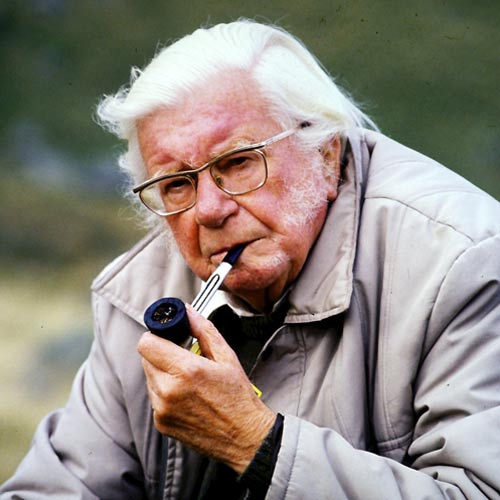
Alfred Wainwright MBE
Born in Blackburn, Lancashire, Wainwright first visited the Lake District in 1930 and was so captivated that he relocated to Kendal in 1941, working as Borough Treasurer while spending every spare moment exploring and mapping the fells.
Between 1955 and 1966 he produced his seven Pictorial Guides to the Lakeland Fells — entirely hand-written and illustrated, describing 214 fells in meticulous detail. His final major work, A Coast to Coast Walk (1973), is widely considered his masterpiece — a route that deliberately seeks out the highest ground, the wildest valleys and the most dramatic ridgelines. Fifty years later, the line he drew remains the definitive way to cross England on foot.
“All I ask for, at the end, is a last long resting place by the side of Innominate Tarn, on Haystacks… if you, dear reader, should get a bit of grit in your boot as you are crossing Haystacks in the years to come, please treat it with respect. It might be me.”— Alfred Wainwright, Memoirs of a Fellwalker
The Challenge
An estimated 6,000–10,000 people walk the Coast to Coast each year. Most do so between May and September, using baggage transfer services to carry their luggage between accommodations while they walk with a light daypack. That is a wonderful way to experience this route — but it is not the walk we have planned.
○ Supported C2C Itinerary
- ○ Summer season (June–August)
- ○ Baggage transfer between accommodations
- ○ Light daypack (3–5 kg)
- ○ B&Bs and guesthouses each night
- ○ Warm, long days (16+ hours daylight)
- ○ Well-trodden paths, other walkers daily
◆ Wise Coast to Coast 2026
- ◆ Late March — winter conditions on high ground
- ◆ Fully self-supported — everything on our backs
- ◆ Full expedition pack (13–15 kg)
- ◆ 4 wild camps above 400m including summits
- ◆ Overnight temps as low as –10°C
- ◆ Drone carried throughout for aerial photography
Walking in late March means winter conditions on the high fells — summit camps at Haystacks (597m), Cringle Moor (432m) and Glaisdale Moor (400m) require four-season tents, –10°C sleeping bags and full winter navigation equipment. There are no baggage vans or support vehicles, and every piece of camping, cooking and survival equipment is carried in a single expedition pack across all 174 miles and 23,000 feet of ascent.
A drone is also being carried throughout to capture aerial photography of some of the most spectacular landscapes in England — adding weight to an already heavy pack, but the images will be worth it!
Of the thousands who walk the Coast to Coast each year, very few attempt it fully self-supported with wild camping in winter conditions.
Our Route
Our 16-day itinerary balances wild camping on high ground with nights in characterful traditional pubs and small hotels. The pattern is deliberate: push hard on the fells, recover properly, push again.
Four nights wild camping at altitude. Traditional pubs with real fires and local ales — including Tan Hill Inn (Britain’s highest at 528m) and the Lion Inn at Blakey Ridge (16th century, completely remote on the moor). Small hotels in Grasmere and Reeth for proper recovery between the hard days.
Brother Ben joins for the final five days from Richmond, transforming solo endurance into shared endeavour for the push across the Vale of Mowbray and the North York Moors to the finish at Robin Hood’s Bay.
Support the Walk
We’re raising £1,740 for the Gwennili Trust — £10 for every mile walked. Every penny goes to offshore sailing for wounded, injured and sick military veterans.
Sponsor Us →